
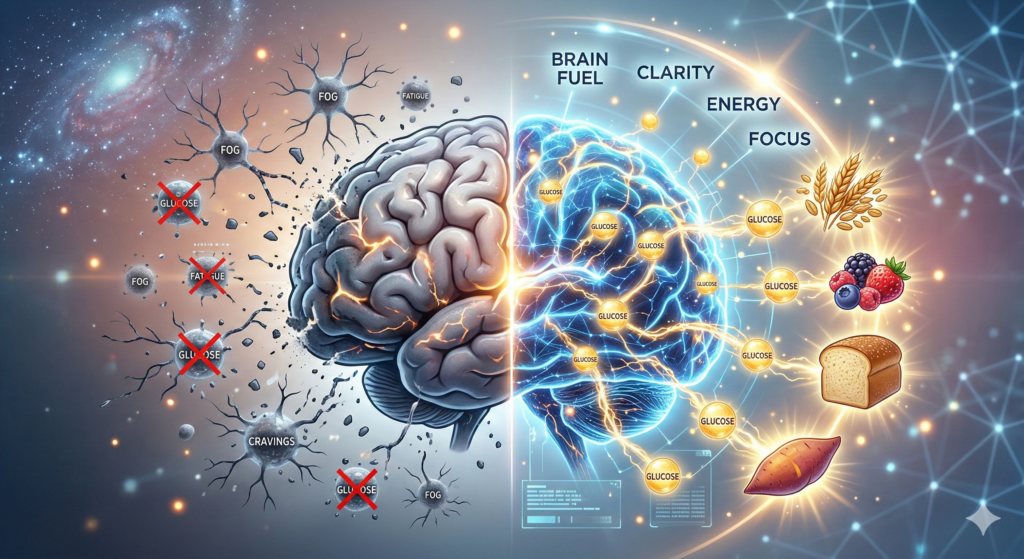
For years, carbohydrates have been treated like the villain of modern nutrition.
“Cut carbs.”
“Avoid sugar.”
“Bread makes you gain weight.”
In the middle of keto trends and carb-phobia culture, one critical biological truth got lost:
Your brain runs on carbohydrates.
Not as an option.
Not as a luxury.
As a priority.
If you’ve ever experienced brain fog, irritability, sudden fatigue, or intense cravings during a low-carb phase — your body wasn’t weak.
It was under-fueled.
Let’s break this down clearly and scientifically — without extremes, without fear, and without diet dogma.
The Biological Priority: Your Brain Runs on Glucose
Your brain represents about 2% of your body weight — yet it consumes roughly 20% of your daily energy.
That energy primarily comes from glucose.
Glucose is derived from carbohydrates.
While the body can adapt to alternative fuels under extreme conditions, its preferred, most efficient energy source is glucose.
Your brain, nervous system, and red blood cells rely heavily on it to function properly.
Think of your body as a high-performance engine.
You wouldn’t put low-grade fuel in a Ferrari.
Carbohydrates are your brain’s premium fuel.
When glucose availability drops significantly, cognitive performance often follows:
- Reduced concentration
- Slower reaction time
- Mood instability
- Mental fatigue
This isn’t psychological weakness.
It’s physiology.
What Happens When You Cut Carbs Too Aggressively?
Short-term carbohydrate restriction can produce rapid weight changes (mostly from glycogen and water loss).
But when carbohydrates are drastically reduced for extended periods without proper structure, several things can happen:
Brain Fog and Reduced Focus
Without adequate glucose, mental clarity often suffers.
Increased Irritability
Low energy availability affects neurotransmitter balance.
Performance Decline
Muscles rely heavily on stored carbohydrates (glycogen) during activity.
Rebound Cravings
When the body feels deprived of its preferred fuel, it increases hunger signals.
Many people interpret this as “lack of discipline.”
In reality, it’s biology pushing back.
Not All Carbohydrates Are Created Equal
This is where nuance matters.
There are two broad categories:
Simple Carbohydrates
Fast-digesting.
Quick energy.
Examples:
- Sugary drinks
- Sweets
- White pastries
These often cause rapid spikes and crashes when consumed alone.
However — and this is important — not all simple carbs are harmful.
Whole fruits and milk also contain simple carbohydrates, but they come packaged with:
- Fiber
- Protein
- Vitamins
- Minerals
The “packaging” changes the metabolic response.
An apple is not the same as apple juice.
Context matters.
Complex Carbohydrates
Slower digestion.
Steady energy release.
Examples:
- Oats
- Brown rice
- Quinoa
- Lentils
- Beans
- Vegetables
These provide what most people actually want:
Stable energy.
And the key player here is fiber.
Fiber slows digestion, stabilizes blood sugar, supports gut health, and improves satiety.
If simple carbs are like lighting a match,
complex carbs are like placing a steady log in a fireplace.
One flares up quickly.
The other sustains warmth.
The Smart Fuel Framework: How to Use Carbs Strategically
Health optimization is not about elimination.
It’s about selection and structure.
Here is a simple framework you can apply immediately:
Base Your Meals on Complex Carbohydrates
Build meals around oats, rice, potatoes, legumes, or whole grains.
Pair Simple Carbs With Protein or Fiber
Fruit + Greek yogurt
Milk + nuts
Bread + eggs
This slows glucose absorption.
Limit Isolated Added Sugars
Liquid sugar and highly refined snacks provide energy without stability.
Think “Stable Energy,” Not “Quick Energy”
Your goal isn’t a spike.
It’s sustained productivity.
Carbohydrates and Long-Term Productivity
Most people don’t struggle with motivation.
They struggle with unstable energy.
When your brain receives consistent fuel:
- Focus improves
- Mood stabilizes
- Decision-making sharpens
- Cravings decrease
Nutrition is not just about aesthetics.
It’s about neurological performance.
You are not just feeding your appetite.
You are fueling your cognitive output.
The Real Shift: From Carb Fear to Carb Strategy
Carbohydrates are not the problem.
Poor structure is.
Your body craves carbohydrates because it wants efficiency.
Instead of fighting your biology, support it.
Choose quality sources.
Pair intelligently.
Aim for stability.
That’s how you move from random dieting to structured fueling.
Final Thought
Every meal is a performance decision.
Not just for your body —
but for your brain.
The real question isn’t:
“Should I cut carbs?”
It’s:
“Am I fueling my brain to perform at its best?”