
Protein is often treated like a fitness accessory.
Something people talk about after a workout.
Something associated with gym culture and muscle building.
But from your body’s perspective, protein is not optional.
It is structural.
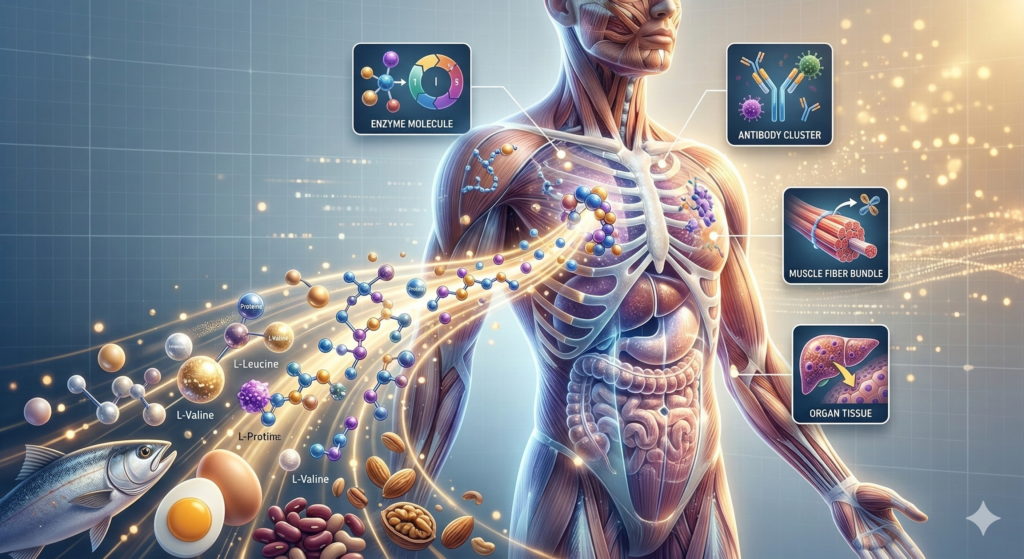
Protein provides the raw materials your body uses to build, repair, and maintain nearly every system that keeps you alive. From your muscles and organs to your enzymes and immune defenses, protein is the biological infrastructure that keeps everything functioning.
Understanding protein is not about building bigger muscles.
It’s about maintaining the integrity of your entire body.
The Body’s Construction Material
The simplest way to understand protein is to think of it as your body’s construction material.
Proteins are made from smaller units called amino acids. These amino acids act like biological building blocks that your body uses to constantly rebuild itself.
Every day your body is:
- repairing damaged tissues
- replacing old cells
- producing enzymes
- creating hormones
- supporting immune defenses
All of these processes require amino acids.
Without them, the body cannot properly maintain its own structure.
This is why protein is often called the body’s building blocks — because quite literally, your body is built from it.
What Happens If You Don’t Eat Enough Protein?
Here is where things become biologically interesting.
Your body cannot store large reserves of amino acids the way it stores carbohydrates or fat. That means it must constantly obtain protein through food.
If dietary protein intake becomes insufficient for an extended period, your body has to look elsewhere.
And the most accessible source of amino acids inside your body is muscle tissue.
To maintain critical functions such as enzyme production, hormone regulation, and immune defense, the body may begin breaking down muscle proteins to obtain the amino acids it needs.
This process is known as muscle protein breakdown.
It’s not dramatic or immediate, but over time it can contribute to:
- loss of muscle mass
- reduced physical strength
- slower recovery
- weakened immune resilience
Your body prioritizes survival over structure.
That means maintaining vital biological functions will always come before preserving muscle tissue.
Protein Does Much More Than Build Muscle
Many people associate protein exclusively with muscle growth.
But muscles are only one part of the story.
Protein also plays essential roles in:
Enzyme Production
Enzymes control thousands of chemical reactions in the body, including digestion and metabolism.
Hormone Regulation
Many hormones that regulate metabolism, appetite, and mood rely on protein structures.
Immune Defense
Antibodies, which help your body fight infections, are specialized proteins.
Tissue Repair
Skin, hair, nails, organs, and connective tissues all require protein for maintenance and repair.
In other words, protein is involved in almost every biological process that keeps your body functioning properly.
Complete vs Incomplete Proteins
Another important concept is protein quality.
Your body requires nine essential amino acids that it cannot produce on its own. These must come from your diet.
Protein sources are often classified as either complete or incomplete.
Complete Proteins
Contain all essential amino acids.
Examples include:
- meat
- fish
- eggs
- dairy
- soy
Incomplete Proteins
Contain some, but not all, essential amino acids.
Examples include:
- beans
- lentils
- nuts
- seeds
- most grains
This doesn’t mean plant proteins are inferior. It simply means variety is important.
Combining different protein sources throughout the day helps ensure your body receives the full range of amino acids it needs.
Can Protein Be Used for Energy?
Your body prefers to use carbohydrates and fats for energy.
However, protein can act as a backup fuel source when energy availability becomes limited.
In these situations, amino acids can be converted into glucose through a process called gluconeogenesis.
But this is not protein’s primary role.
Using protein for energy is metabolically inefficient and means fewer amino acids are available for tissue repair, immune support, and structural maintenance.
Which is why adequate protein intake is important for long-term health.
How to Make Smarter Protein Choices
Improving protein intake does not require complicated strategies.
A few simple principles go a long way.
1. Prioritize Lean Protein Sources
Choose fish, poultry, eggs, dairy, or lean cuts of meat.
2. Include Plant-Based Protein Foods
Beans, lentils, nuts, and seeds provide valuable nutrients and fiber.
3. Combine Different Protein Sources
Mix plant and animal proteins or combine plant sources to improve amino acid balance.
4. Limit Highly Processed Meats
Focus on whole-food sources instead of heavily processed products.
These choices help support the body’s constant need for amino acids.
Protein and Long-Term Health
Protein is not just about strength.
It is about maintenance.
Your body is constantly rebuilding itself, replacing damaged cells, repairing tissues, and supporting immune function.
Protein provides the raw materials that make this possible.
Without sufficient intake, your body eventually has to shift from building to conserving — and in some cases, breaking down its own resources.
The goal of nutrition is not simply to fuel today.
It is to maintain your body’s structure for the long term.
Final Thought
Every meal provides your body with instructions.
Either it receives the materials it needs to build and repair — or it has to adapt with what is available.
Protein is one of the most fundamental materials your biology depends on.
The real question is simple:
Are you giving your body the building blocks it needs to stay strong?