
When people feel tired, one of the most common reactions is simple:
“Maybe I need more vitamins.”
Energy drinks advertise B-vitamins.
Supplements promise vitality and energy boosts.
But here is a surprising biological fact:
Vitamins do not provide energy.
Not a single calorie.
So why are they so important for energy and overall health?
Because vitamins do something far more interesting.
They help your body unlock the energy already present in your food.
The Energy Myth: Vitamins Are Not Fuel
Your body gets energy from calories.
Those calories come from macronutrients:
- carbohydrates
- fats
- proteins
These nutrients are broken down during digestion and converted into usable energy.
Vitamins, however, contain zero calories.
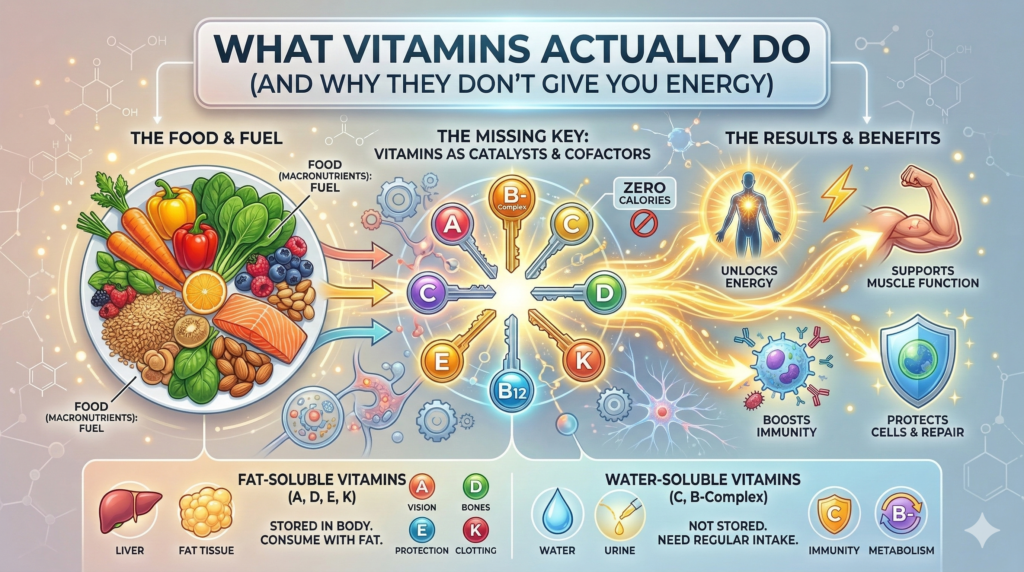
Instead, they act as cofactors and catalysts — tiny chemical helpers that allow thousands of biological reactions to occur.
Think of it like this:
Food is the fuel in the tank.
Vitamins are the key that starts the engine.
Without that key, the fuel is useless.
This is why vitamin deficiencies can lead to fatigue even when a person is eating enough calories.
The Hidden Role of Vitamins in the Body
Although vitamins are required in small amounts, they are involved in an enormous number of biological processes.
Some of their most important roles include:
Supporting Energy Metabolism
Vitamins help enzymes convert food into usable cellular energy.
Strengthening the Immune System
Several vitamins support immune cell function and defense mechanisms.
Protecting Cells
Certain vitamins act as antioxidants, helping neutralize harmful molecules called free radicals.
Supporting Growth and Repair
Vitamins contribute to tissue repair, hormone production, and healthy cell function.
Without these microscopic helpers, many essential processes in the body would slow down or stop.
Fat-Soluble vs Water-Soluble Vitamins
Vitamins are divided into two main groups depending on how your body absorbs and stores them.
Fat-Soluble Vitamins
These vitamins dissolve in fat and can be stored in the body’s liver and fatty tissues.
They include:
- Vitamin A
- Vitamin D
- Vitamin E
- Vitamin K
Because they are stored, they do not necessarily need to be consumed every single day.
However, they must be consumed with dietary fat to be absorbed properly.
Water-Soluble Vitamins
These vitamins dissolve in water and are not stored in large amounts in the body.
They include:
- Vitamin C
- B-complex vitamins (B1, B2, B3, B5, B6, B7, B9, B12)
Since excess amounts are excreted through urine, these vitamins generally require regular daily intake.
This is why foods rich in B-vitamins and vitamin C are important parts of a balanced diet.
Where Do Vitamins Come From?
The best source of vitamins is a varied diet rich in whole foods.
One of the simplest nutritional guidelines is often summarized as:
Eat the rainbow.
Different colors in fruits and vegetables often indicate different vitamins and phytonutrients.
Examples include:
Red and Orange Foods
Carrots, peppers, citrus fruits, berries
→ rich in vitamins A and C
Dark Green Vegetables
Spinach, broccoli, kale
→ rich in vitamins K, A, and C
Whole Grains and Legumes
Beans, lentils, oats
→ rich in B vitamins
Protein-Rich Foods
Eggs, fish, dairy
→ sources of vitamins A, D, and B12
Nuts and Seeds
→ good sources of vitamin E
A diverse diet helps ensure the body receives the full spectrum of vitamins it needs.
Why Variety Matters
Unlike macronutrients, vitamins work together in complex networks.
They support enzymes, assist metabolic reactions, and help regulate biological systems.
No single vitamin works in isolation.
This is why overall dietary variety is more effective than relying on one specific food or supplement.
Balanced nutrition provides the combination of nutrients your body needs to function efficiently.
Final Thought
Vitamins may be small, but their impact on the body is enormous.
They do not supply energy themselves.
Instead, they allow your body to convert food into usable fuel, support immune defenses, protect cells, and maintain healthy metabolism.
The real goal is not chasing quick energy fixes.
It is building a nutritional foundation that supports the body’s natural systems.
So the next time you prepare a meal, ask yourself:
Am I just eating calories — or am I giving my body the helpers it needs to actually use them?