
For decades, dietary fat was treated like the villain of nutrition.
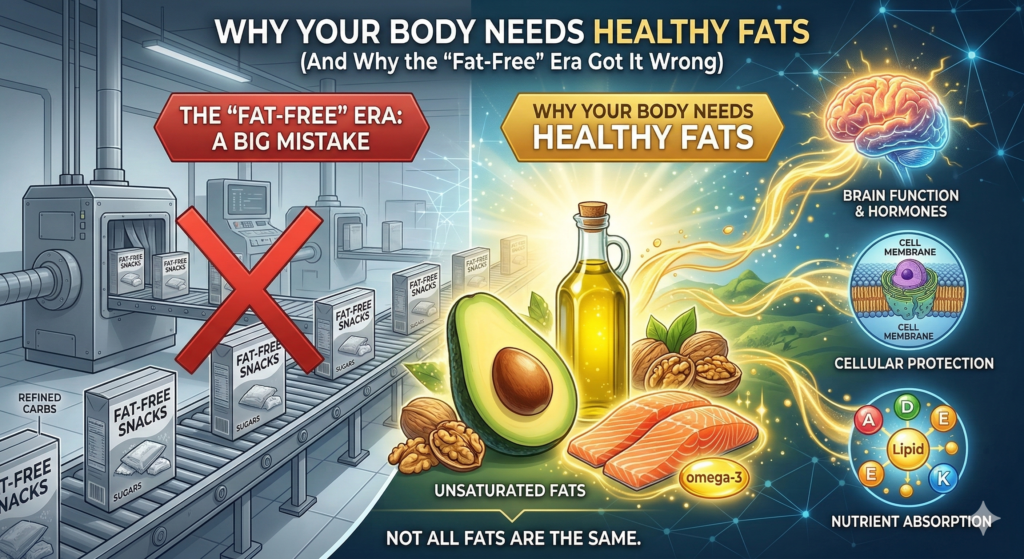
Supermarket shelves filled with “fat-free” snacks.
Diet plans built around eliminating fats.
A widespread belief that fat automatically meant poor health.
But modern nutrition science has largely corrected that misunderstanding.
Fat is not something your body tolerates.
It is something your body requires.
Far from being just a dense source of calories, fats play critical roles in hormone production, brain function, nutrient absorption, and cellular protection.
Understanding fat is not about avoiding it.
It’s about choosing the right types.
The Fat-Free Myth: How Nutrition Got It Wrong
The low-fat movement that became popular in the late 20th century was built on a simplified idea:
Less fat equals better health.
In reality, many of those “fat-free” foods replaced fats with refined carbohydrates and sugars.
The result?
People often consumed more processed foods while eliminating nutrients their bodies actually needed.
Today we know that removing healthy fats from the diet can disrupt several essential biological systems.
Your body doesn’t simply burn fat for energy.
It uses it to build and regulate key parts of your physiology.
Why Fat Is Essential for Hormone Production
One of the most important roles of dietary fat is hormone regulation.
Hormones are chemical messengers that control many critical processes in the body, including:
- metabolism
- mood
- appetite regulation
- reproductive health
Many hormones are synthesized using cholesterol and fatty acids as structural components.
When dietary fat intake becomes chronically too low, it can interfere with the body’s ability to maintain hormonal balance.
This is one reason extremely low-fat diets may negatively affect long-term health.
Your endocrine system depends on adequate fat intake to function properly.
Fat Builds and Protects Your Cells
Every cell in your body is surrounded by a protective membrane.
And that membrane is largely made of fat.
These membranes control what enters and exits each cell, helping maintain stability and communication throughout your body.
Without sufficient fat in the diet, the body struggles to maintain optimal cell structure and function.
Fat is also especially important for the nervous system.
Certain fatty acids help support the protective insulation around nerve cells, allowing signals to travel efficiently between the brain and the rest of the body.
In other words, fat literally helps your brain communicate with your body.
Fat Helps You Absorb Essential Vitamins
Another critical function of dietary fat is nutrient absorption.
Some vitamins are fat-soluble, meaning they require fat to be absorbed and used by the body.
These include:
- Vitamin A
- Vitamin D
- Vitamin E
- Vitamin K
Without adequate fat in a meal, your body may struggle to absorb these nutrients effectively.
This means that even a nutrient-rich diet may become less beneficial if fat intake is too low.
Fat acts as the transport system that allows these vitamins to move from the digestive system into your bloodstream.
Not All Fats Are the Same
One of the biggest mistakes in nutrition discussions is treating all fats as identical.
In reality, fats fall into several categories with different effects on health.
Unsaturated Fats (Choose Mostly)
These are generally considered the most beneficial fats for overall health.
Sources include:
- olive oil
- avocados
- nuts and seeds
- fatty fish like salmon and sardines
Unsaturated fats support heart health and provide essential fatty acids your body cannot produce on its own.
Saturated Fats (Consume in Moderation)
These fats occur naturally in many animal foods and some plant sources.
Examples include:
- red meat
- butter
- cheese
- coconut oil
They can be part of a balanced diet but should not dominate total fat intake.
Trans Fats (Avoid)
Trans fats are largely industrially produced fats found in many processed foods.
They are associated with negative health outcomes and should be minimized or avoided.
Common sources include:
- fried fast foods
- packaged snacks
- baked goods made with partially hydrogenated oils
Avoiding these fats is one of the simplest steps toward improving dietary quality.
The Smart Fat Strategy
Healthy nutrition is rarely about complete elimination.
It’s about better selection.
A few simple habits can help improve the quality of fat in your diet.
1. Cook with Healthy Oils
Use olive oil instead of highly processed vegetable oils.
2. Include Fatty Fish Regularly
Fish rich in omega-3 fatty acids support brain and heart health.
3. Add Nuts, Seeds, or Avocado to Meals
These provide healthy fats along with fiber and micronutrients.
4. Limit Highly Processed Foods
Many processed foods contain unhealthy fat combinations.
Small adjustments can significantly improve the quality of fats in your diet.
Final Thought
Fat is not the enemy.
Your body depends on it for hormone balance, cellular protection, nutrient absorption, and long-lasting energy.
The real goal is not to eliminate fat.
It is to understand it.
When you focus on quality sources and balanced intake, fat becomes one of the most powerful nutritional tools available.
The next time you prepare a meal, ask yourself a simple question:
Is this meal providing the healthy fats my body needs to function at its best?