
When people think about nutrition, the conversation often focuses on calories, protein, or vitamins.
But beneath all of those nutrients lies another critical group that quietly keeps your body functioning:
Minerals.
Minerals are essential elements your body needs to maintain structure, regulate biological systems, and support countless chemical reactions.
They help your body stay strong, balanced, and functioning properly — from your bones and muscles to your nerves, fluids, and metabolism.
Although required in relatively small amounts, minerals are involved in nearly every major physiological process.
Why Minerals Are Essential for the Body
Minerals play several important roles in maintaining health.
They help:
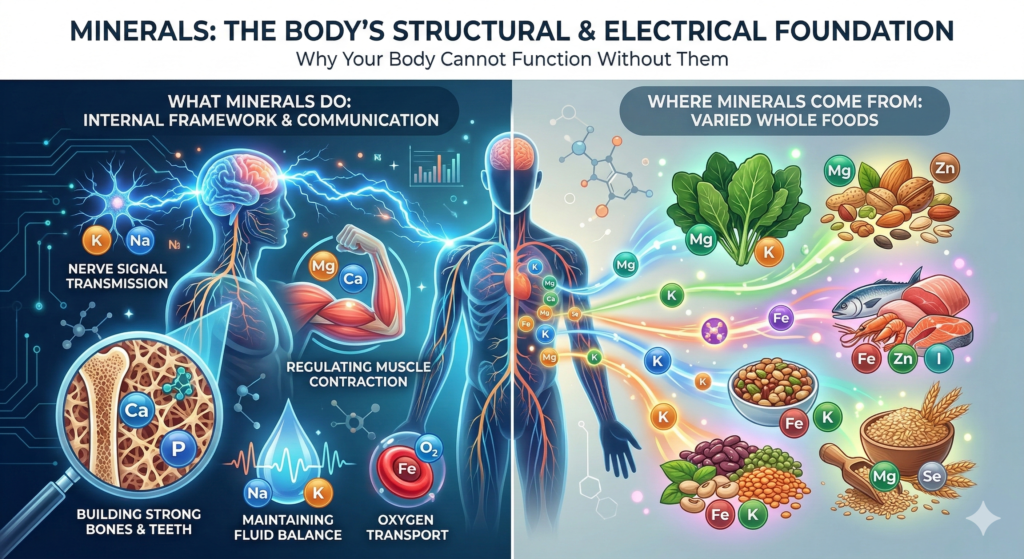
- build strong bones and teeth
- transmit nerve signals
- regulate muscle contractions
- maintain fluid balance
- support metabolism and energy production
Think of minerals as the structural engineers and electrical technicians of your body.
They help build your internal framework while also enabling the electrical signals that allow the brain, nerves, and muscles to communicate.
Without these microscopic elements, many basic functions of the body would stop working properly.
Major Minerals vs Trace Minerals
Minerals are divided into two main groups based on how much the body needs.
This distinction refers to quantity, not importance.
Major Minerals
Major minerals are required in larger amounts because they support major physiological systems.
Examples include:
Calcium
Supports bone strength, muscle contraction, and nerve transmission.
Potassium
Helps regulate heart rhythm, fluid balance, and nerve signals.
Magnesium
Participates in hundreds of enzyme reactions related to metabolism and muscle relaxation.
Sodium and Chloride
Help regulate fluid balance and nerve signaling.
Phosphorus
Supports bone health and plays an essential role in cellular energy production.
These minerals form the structural and electrical foundation of many biological processes.
Trace Minerals
Trace minerals are required in much smaller amounts, but they are still essential.
Even tiny deficiencies can disrupt important systems in the body.
Important trace minerals include:
Iron
Helps transport oxygen through the bloodstream.
Zinc
Supports immune function and wound healing.
Iodine
Essential for thyroid hormone production and metabolism regulation.
Selenium
Acts as an antioxidant and supports thyroid function.
Copper and Manganese
Help maintain metabolism and support connective tissues.
Although the body needs only small quantities, these minerals perform highly specialized functions.
Minerals and Fluid Balance
One of the most important roles of minerals is maintaining fluid and electrolyte balance.
Electrolytes such as sodium, potassium, and chloride help regulate the movement of fluids in and out of cells.
This balance is essential for:
- nerve transmission
- muscle contraction
- heart rhythm
- hydration levels
If this mineral balance is disrupted, communication between the brain and the body can be affected.
That is why electrolyte balance is essential for normal physiological function.
Where Do Minerals Come From?
The best source of minerals is a varied diet that includes whole, nutrient-dense foods.
Some examples include:
Dairy or Fortified Alternatives
Sources of calcium.
Nuts and Seeds
Rich in magnesium and zinc.
Lean Meats and Seafood
Provide iron, zinc, and iodine.
Beans and Lentils
Contain iron, magnesium, and potassium.
Fruits and Vegetables
Bananas, potatoes, and leafy greens provide potassium and other essential minerals.
Eating a variety of whole foods helps ensure the body receives a balanced range of minerals.
Why Processed Foods Can Disrupt Mineral Balance
Highly processed foods often contain excessive sodium while lacking other important minerals.
This imbalance can disrupt fluid regulation and increase strain on certain physiological systems.
Focusing more on whole foods and less on heavily processed products helps maintain a healthier mineral balance.
Final Thought
Minerals may be invisible, but their impact on your body is enormous.
They help build your bones, regulate your heartbeat, support nerve communication, and maintain the balance of fluids inside your body.
Without them, the complex systems that keep you alive would not function properly.
The good news is that you do not need exotic supplements to obtain them.
Most minerals come from the same place good nutrition always begins:
a diverse diet of whole foods.
So the next time you prepare a meal, consider not just the calories or the protein.
Ask yourself a deeper question:
Is this meal giving my body the minerals it needs to stay strong and balanced?